As smart as a rook, fascinating facts about the intelligence of corvids
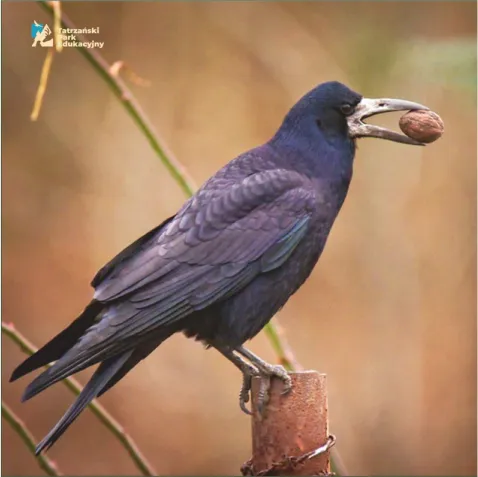
As smart as a rook?
In our country, winter has firmly settled in. Sometimes it seems to us that during this period many remarkable bird species have left us. However, one of the most interesting birds in the world is still with us. This bird is the common, unnoticed and underappreciated rook.
Rooks, geniuses of the animal world
Rooks are among the most intelligent creatures on earth. They show, among other things, high social intelligence similar to that of primates. It is higher in bird species that enter long term relationships, and rooks try to form pairs for life.
Affection and bonds in pairs
We can even observe certain forms of cementing this bond. Corvids (the family to which rooks belong) display various forms of physical contact, such as holding a partner’s beak in their own. This resembles human kissing in relationships and serves similar purposes.
Experiment in cooperation
An experiment was also conducted to see the cooperative ability of rooks. To get food, two birds had to pull a string together. Only birds that tolerated each other on a daily basis approached this task.
Reconciliation after conflicts
They also exhibit the phenomenon of reconciliation. Reconciliation between two recent enemies is an attempt to repair damaged relations. In rooks, admittedly, reconciliation does not function in pair bonds for a simple reason, they do not quarrel.
However, reconciliatory behavior in corvids functions much more often immediately after a skirmish with a given individual. Such birds are less likely to argue in the future. There also has to be a fairly good relationship between them earlier for reconciliation to be worthwhile.
Tool making ability
There is something we will not observe in rooks in the wild that undoubtedly puts them in the club of the intelligent. We are talking about the ability to create and use tools. In nature they simply do not need them.
Sometimes they use so called pseudo tools, for example if they want to access the contents of a walnut, they grab it in their beak and drop it from a great height onto the road.
Intelligence test, a wire hook
Under laboratory conditions, they were given an insight test. Namely, whether the tools they use owe their effectiveness to trial and error, or whether they imagine them in their minds before starting their handcraft work.
In front of them was a tube and various kinds of wires. They had to extract food from this tube using a hook. Without prior trials, after a brief moment of thought, they began to create a tool by bending a wire of the appropriate length.
Aesop’s fable scientifically confirmed
In Aesop’s fable, a crow drops stones into a pitcher of water to raise its level so that it can then drink. It was decided to check whether there was a grain of truth in this fable.
In a container along with water there was also a treat in the form of a larva, with pebbles lying nearby. The rooks very quickly learned to use the pebbles to raise the water level.
A rook’s intelligence equals that of a 15 year old child
These and other experiments were simpler so that they could be repeated with children and compare the level of development of animals to our own. The most interesting thing about all this is that only 15 year old children showed all the characteristics of rook intelligence.
We hope that with this post we have encouraged you to observe birds in your immediate surroundings, even when the weather is bad. Even from behind a window with a winter tea in hand…