Woodpeckers in the Tatras, the forest doctors, three toed and great spotted woodpecker
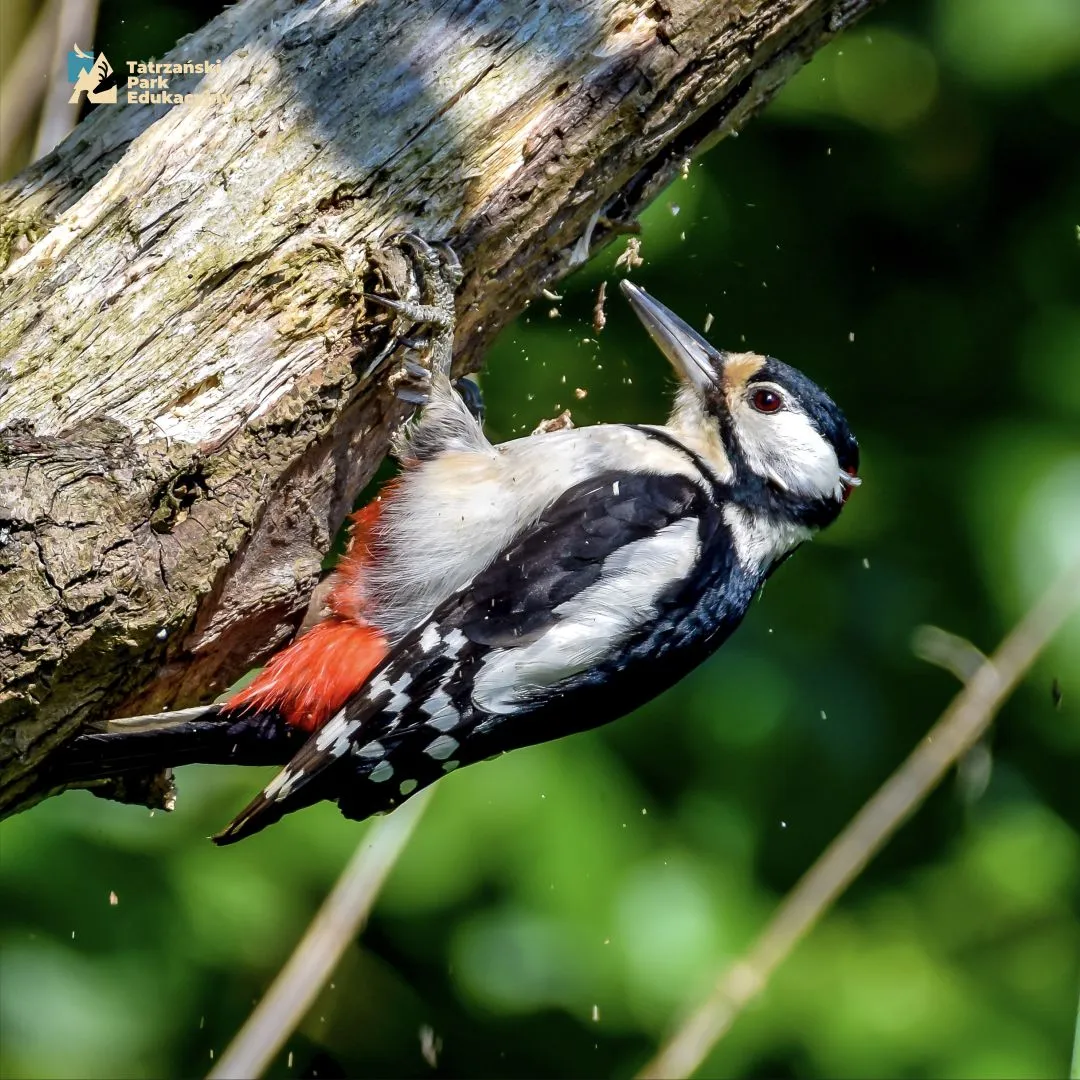
Do trees have their own doctor?
When walking through our Tatra Educational Park or through the lower forest in spring, you can often hear a distinctive tapping sound. It is, of course, a woodpecker.
Woodpeckers in the Tatras
In the Tatras, seven species of this bird are found, but around our Park you can most often encounter two species that feed on spruce trees, the three toed woodpecker and the great spotted woodpecker.
Three toed woodpecker, the bark beetle slayer
The first differs from the others in the number of toes, as the name implies, it has three instead of four, and it lacks the characteristic red plumage element. It has taken a liking to spruce trees and feeds mainly on them. It uses, however, trees that are already drying out or completely dead.
The main, though not the only, component of its diet is bark beetles and their larvae. Annually, the three toed woodpecker eats over half a million bark beetles! Especially in spring and early summer, however, it is also tempted by the larvae of other beetles living under the bark.
The three toed woodpecker nests in tree hollows usually carved out in dead spruces. This shows that leaving dead trees in the forest is important for ecological balance.
Great spotted woodpecker, the loud forest tenant
The great spotted woodpecker is not actually the largest Tatra woodpecker. This bird also feeds on bark beetles, but forages on living trees, so its activity can genuinely contribute in a natural way to reducing the numbers of these insects. It is very loud and in the breeding season taps not only on trees but also on buildings, antennas, and so on.
Woodpeckers as creators of forest shelters
Woodpeckers are exceptional birds. They create tree hollows for themselves, but as a result they create forest shelters for a whole array of secondary cavity nesters, including owls and tits, but also mammals such as squirrels.
How does a woodpecker drum without a headache?
How is it possible that woodpeckers drum on hard wood without a headache? Behind this lies the special structure of the beak, head and skull. The woodpecker’s beak is asymmetrical, its longer maxillary part transfers the impact force to very strong head muscles. Additionally, the skull and its bones have a specific structure providing a buffer for strong impacts.
If you hear tapping above your heads, look for a woodpecker. Watching its work is truly fascinating!