The European spruce bark beetle in the Tatras, pest or natural part of the ecosystem
Bark beetle, pest or doctor?
When visiting our Tatra Educational Park, you may notice that it sits next to a forest, and within the park itself we have tried to preserve the natural tree stand. What trees dominate the area around us?
These are spruces, some beautiful and strong, others already attacked by the bark beetle, weakened or even dead. Note! This is a perfectly natural process of forest restoration.
Do we fight the bark beetle?
Apart from felling trees that threaten your safety during visits to the TPE, we do not fight the bark beetle, because its activity is a natural process. So who is this bark beetle, and is its activity in the Tatras and Podhale something we should fear?
What is the European spruce bark beetle?
The European spruce bark beetle (Ips typographus) is a small beetle about 4.5 mm long, capable of flying distances of up to a dozen kilometers. This ability proves useful in spring, when the beetle ends its hibernation period and sets off in search of the perfect place to establish a feeding site in a spruce.
Life cycle of the bark beetle and characteristic patterns
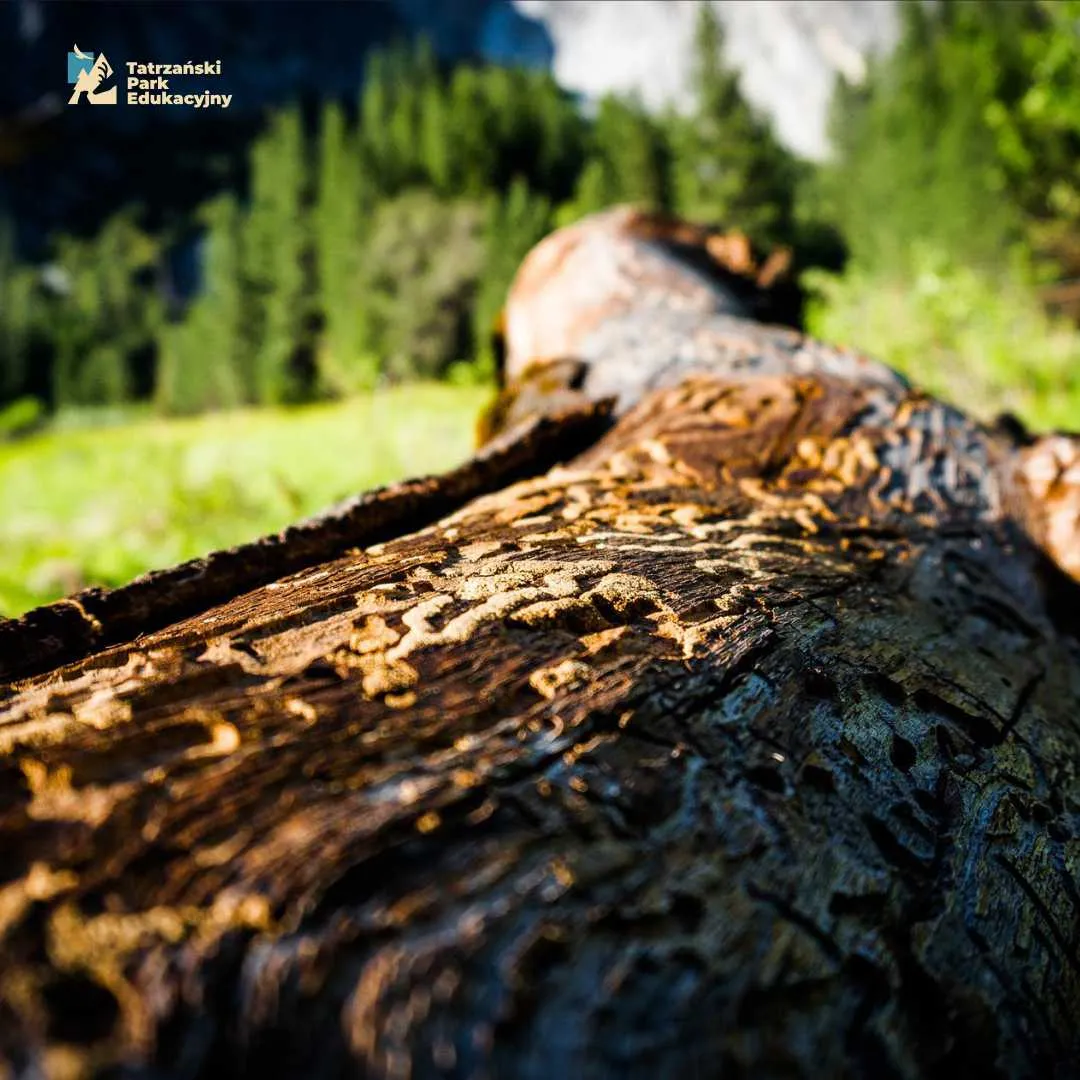
The male colonizes fallen, broken or weakened trees and bores a mating chamber in their bark, where it attracts females. These in turn bore maternal galleries, where they lay their eggs, and the larvae that hatch from them bore larval galleries. In this way, a characteristic and very impressive pattern is formed on the inner side of the bark, from which the European spruce bark beetle takes its English name (typographus meaning printer).
The weather determines the number of beetle generations. In the lower forest zone where our park is located, there can be two generations per year. Climate change and long warm summers favor the rapid development of this beetle.
Death of the spruce and the role of the bark beetle
Unfortunately, the bark beetle’s feeding means death for the spruce, whether through mechanical damage to the phloem, in which the beetle bores its galleries, or through fungi carried by these creatures.
In a state of ecological balance within the ecosystem, bark beetles colonize only weak trees. If this balance is disturbed, for example by the destructive halny wind in the Tatras, when hectares of forest are felled, a bark beetle outbreak may occur, that is a sudden increase in its population and thus an increase in its aggressiveness.
Such a situation prevails in the Tatras today. After the halny of 2013, which knocked down vast stretches of forest in the Western Tatras, a bark beetle outbreak is taking place in this region, including in the Las Białego forest that borders our Park.
Natural forest restoration
Let us remember, however, that a uniform spruce forest is not the natural tree stand for the Tatras (more on this in one of the upcoming posts). The die off of spruce, although a rather sad sight, gives a chance for the forest to brighten up and for the development of other tree species, those more natural to the lower forest zone.
See for yourself during your visit to our Park how many young firs are developing under the dead spruces. There are also birds that benefit greatly from this situation (we will write about this soon). Forest restoration is a truly fascinating process!